Showing posts with label Literary fiction. Show all posts

Saturday, December 25

The Setting Sun - Review

The Setting Sun  

- Osamu Dazai


The Setting Sun by Osamu Dazai
Translated by - Donald Keene
Genre - Literary fiction
Edition - Audiobook
Length - 4hrs 28mins
Audible release - August 2020
Narrator - June Angela
Verdict - 5/5 stars

'Victims. Victims of a transitional period of morality. That is what we both certainly are'

Story - Kazuko, a 29-year-old woman, comes from a Japanese aristocratic family who, along with her widowed mother, is forced to leave their home in Tokyo and move to the Izu Peninsula post the second world war when aristocracy in Japan began to decline. Forced to work in the fields, Kazuko tried to make sense of her new life as a ‘high-class beggar’ while observing her ailing mother minutely, who, for her, is a nostalgic reminder of the days gone by. So, even the way her mother consumes soup in a way, unlike modern etiquette, seems attractive to her.

As Kazuko and her mother try to adjust to their diminished lives, Naoji’s Kazuko’s brother, who seemed lost in action at war, returns. However, Naoji, an ex-opium addict, poses a more challenging situation for the mother and daughter as he drinks away whatever little is left of the family’s wealth. With her mother’s health declining rapidly, Kazuko is desperate to survive in the newly emerging modern Japan, and she does it in the only way she knows best. By falling in love with one of her brother’s alcoholic novelist friends and rejecting her class and identity as a high-class citizen.

My take - Told from Kazuko’s perspective, The Setting Sun is a story about a time when the sun in Japan set on the past glory of aristocracy and gave rise to modern industrial Japan. Kazuko’s and her mother’s transition from a life of luxury and status to poverty and ill-health is heartbreaking and horrifying to imagine.

Kazuko’s mother represents the aristocratic class, and Kazuko herself, a high-class beggar, the byproduct of the new Japan, feels inadequate to even imitate her mother eating soup. She neither accepts the change in her circumstances nor rejects the rise of modern industrial Japan. She simply fades away as the old ways die and the new way gains momentum.

Naoji, on the other hand, represents the repercussions the decline had on the nobility in Japan. He is angry about his connection to the past, but he cannot entirely accept the present condition. ‘ Just because a person has a title doesn’t make him an aristocrat. Some people are great aristocrats who have no other title than the one nature has bestowed on them. And others like us, who have nothing but titles, are close to being pariahs than aristocrats.’

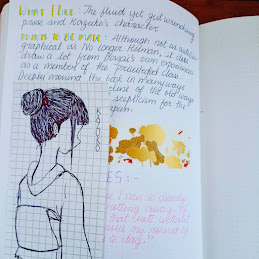
Although not as autobiographical as No Longer Human, The Setting Sun draws, to an extent, from Dazai’s own experiences as one of the privileged class. He had lived a life of splendour and opulence that the novel's protagonists are compelled to give up.

The Setting Sun is an incredibly sad book about the decline of a family, and I couldn’t help draw a comparison between The Setting Sun and The Little Stranger by Sarah Waters, which is also a story about a family living in the ruins of a past glory post-world war II. Like Kazuko, Caroline Ayres also tries her best to make ends meet as her mother’s mental health slowly declines and her brother Roderick, who, like Naoji, is a casualty of the second world war, and has his own demons to fight. I would say that the Setting Sun has a better ending than the Little Stranger where Kazuko, finally decides how she is going to pave her path in the new industrial Japan. So the book is not utterly without hope as No Longer Human, but one can’t help feeling despair and abandonment as one sympathises heavily with Kazuko and her mother.

Friday, February 7

From a distance even dust motes twinkle deluding the human eye - Review of Twinkle Twinkle by Kaori Ekuni


“I try to be careful, but sometimes I fall in love.” Kaori Ekuni in her afterword of the novel.

Mutuski, a gay doctor bordering on OCD is married to Shoko a highly strung, slightly alcoholic woman. Shoko is aware that Mutsuki is gay when their marriage is arranged but she gives her consent readily. She strongly agrees that Mutsuki continues his relationship with his lover Kon, always coaxing him to tell her stories about Kon and their time together. When Mutsuki insists that Shoko should have a boyfriend, she vehemently denies. She doesn't warm up to the idea about having a boyfriend outside her marriage, but she is alright with her husband having a lover outside the marriage.
Sounds bizarre right? Well I thought so too in the beginning, and it took me a while to get into the story. However, it was much later I realised that I had actually fallen in love with this story and its eccentric female character. Shoko is unstable, fiery and drinks more than one should. She feels she’s culpable in fooling Mutsuki into the marriage and cannot stand his kindness. But the truth  is, she is deeply in love with her husband and with the way he is with Kon, knowing that their relationship goes way back to high school days. She desperately wants to have a part of what Mutsuki and Kon have. She wants to be accepted by the two of them and when she cannot get that through to Mutsuki, she retaliates through volatile outbursts and depressive behaviour.
Twinkle Twinkle is not your ordinary story and the simplistic writing does delude you to the point that it may sometimes even bore you in the beginning but if you have the patience, this gem of a story gets to you even before you realise it. It’s a late bloomer appearing cold and stiff in the beginning to the point of frustrating the reader, but slowly unfolds into this heart-warming story of love and a complete understanding of the other half. It also made me rethink about romantic love and its inevitable tie with physical consummation.
“The feeling I had that I was embracing water came not from the loneliness of a sexless marriage, but from the complex we both had about it – the suffocating need to be sensitive to the other’s feelings the whole time.”
Twinkle Twinkle does address the frustrations of societal pressures of how men and women are supposed to conform to their stereotypical roles of man and wife, but the author’s main intent is to tell a love story between unlikely people, and that, love is not something restricted to sexual preferences or the number of people. Love can bloom between any two or even three very different people.
The author mentions in her afterword that one of the chapters “Sleepers and the One that Watcheth” is based on a painting by Simeon Solomon. I looked it up and the author’s intention suddenly became clear to me.
I must add here that only Japanese writers can write about a topic so sensitive and so fragile with such serenity.  I also must give credit to Emi Shimikawa for her brilliant translation. 5 out of 5 stars from me.

Saturday, January 26

Pachinko, A Book Review

                 
                    “History has failed us, but no matter.”


A compelling family saga spanning four generations, Min Jin-Lee’s Pachinko begins in 1910 in Japan occupied Korea, and ends in 1989; the year Lee got the idea for this epic tale. Pachinko opens with the story of Hoonie, the club-footed and cleft-lipped man marrying a fifteen-year-old in Yeongdo a small fishing village in Busan, Korea. It is their daughter Sunja who carries the story forward as she grows up helping her mother in their boarding house. In due time Sunja falls in love with the rich Koh Hansu, an older man who dotes on her and lavishes her with expensive gifts but his affluence comes from dubious quarters. Sunja falls pregnant, but Koh Hansu already has a wife and three girls in Japan - a truth Sunja only learns after she's carrying his child. Luckily for Sunja, Baek Isak a sickly but a compassionate protestant priest offers to give the child a name and a new life in Japan. Sunja follows her husband, a man she barely knows into an inhospitable country, and as they begin their life in Japan together with Yoseb and Kyunghee, Baek Isak’s brother and sister-in-law, a future full of adversity awaits for them but not without a few snatches of happiness.

Undeniably an engaging read, Pachinko is the kind of book that comes by only once in a while. Lee’s eloquent and smooth storytelling keeps the reader thoroughly engrossed. At the heart of it, two resilient women Sunja and Kyunghee, whose indomitable spirit to live with courage and fortitude under adverse circumstances is the kernel of the story. Lee walks us through the history of Korea and Japan through her characters, and she does it with great finesse. What struck me most about this novel was the outrageously inhuman treatment the Koreans received at the hands of the Japanese during the Japanese occupation. One couldn’t even hold on to their names. The advantage laid in being more Japanese and the Koreans in Japan did everything to be Japanese which tore them apart from their countrymen who wouldn’t have them back in Korea. Another thing that struck me about Pachinko was how the male characters with all their complexities, their inadequacies and their failings, highlight the unflinching tenacity of Sunja’s and Kyunghee’s characters, and even Sunja’s mother Yangjin’s character. Lee’s women struggle, suffer irreparable heartbreaks, but they do not get bent out of shape which is the strength of this 531 pages monolithic work of staggering brilliance.
A sweeping journey through the history of adversity between the Koreans and the Japanese during the Japanese occupation, the division of North and South Korea, and it’s repercussions on the proletariat, Pachinko is a heart burner.
As Lee points out, history always fails the low working class readily sacrificed in the strife between two great powers.