Showing posts with label Translated fiction. Show all posts

Saturday, December 25

The Setting Sun - Review

The Setting Sun  

- Osamu Dazai


The Setting Sun by Osamu Dazai
Translated by - Donald Keene
Genre - Literary fiction
Edition - Audiobook
Length - 4hrs 28mins
Audible release - August 2020
Narrator - June Angela
Verdict - 5/5 stars

'Victims. Victims of a transitional period of morality. That is what we both certainly are'

Story - Kazuko, a 29-year-old woman, comes from a Japanese aristocratic family who, along with her widowed mother, is forced to leave their home in Tokyo and move to the Izu Peninsula post the second world war when aristocracy in Japan began to decline. Forced to work in the fields, Kazuko tried to make sense of her new life as a ‘high-class beggar’ while observing her ailing mother minutely, who, for her, is a nostalgic reminder of the days gone by. So, even the way her mother consumes soup in a way, unlike modern etiquette, seems attractive to her.

As Kazuko and her mother try to adjust to their diminished lives, Naoji’s Kazuko’s brother, who seemed lost in action at war, returns. However, Naoji, an ex-opium addict, poses a more challenging situation for the mother and daughter as he drinks away whatever little is left of the family’s wealth. With her mother’s health declining rapidly, Kazuko is desperate to survive in the newly emerging modern Japan, and she does it in the only way she knows best. By falling in love with one of her brother’s alcoholic novelist friends and rejecting her class and identity as a high-class citizen.

My take - Told from Kazuko’s perspective, The Setting Sun is a story about a time when the sun in Japan set on the past glory of aristocracy and gave rise to modern industrial Japan. Kazuko’s and her mother’s transition from a life of luxury and status to poverty and ill-health is heartbreaking and horrifying to imagine.

Kazuko’s mother represents the aristocratic class, and Kazuko herself, a high-class beggar, the byproduct of the new Japan, feels inadequate to even imitate her mother eating soup. She neither accepts the change in her circumstances nor rejects the rise of modern industrial Japan. She simply fades away as the old ways die and the new way gains momentum.

Naoji, on the other hand, represents the repercussions the decline had on the nobility in Japan. He is angry about his connection to the past, but he cannot entirely accept the present condition. ‘ Just because a person has a title doesn’t make him an aristocrat. Some people are great aristocrats who have no other title than the one nature has bestowed on them. And others like us, who have nothing but titles, are close to being pariahs than aristocrats.’

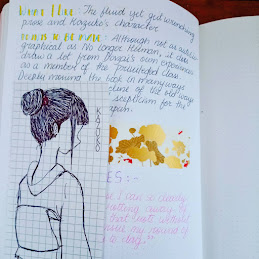
Although not as autobiographical as No Longer Human, The Setting Sun draws, to an extent, from Dazai’s own experiences as one of the privileged class. He had lived a life of splendour and opulence that the novel's protagonists are compelled to give up.

The Setting Sun is an incredibly sad book about the decline of a family, and I couldn’t help draw a comparison between The Setting Sun and The Little Stranger by Sarah Waters, which is also a story about a family living in the ruins of a past glory post-world war II. Like Kazuko, Caroline Ayres also tries her best to make ends meet as her mother’s mental health slowly declines and her brother Roderick, who, like Naoji, is a casualty of the second world war, and has his own demons to fight. I would say that the Setting Sun has a better ending than the Little Stranger where Kazuko, finally decides how she is going to pave her path in the new industrial Japan. So the book is not utterly without hope as No Longer Human, but one can’t help feeling despair and abandonment as one sympathises heavily with Kazuko and her mother.

Wednesday, December 22

Goth - Review

Goth 

- Otsuichi


Translated by: Andrew Cunningham
Published in English: Aug 2015
Edition - Paperback
Genre - Horror
Pages - 295
TW - Suicide, death, murder, corpses

 'We each had detected what the other was hiding from those around us'

Story: Kamiyama Itsuki has been drawn to Morino Yoru since he first saw her in high school. Obsessed with death and corpses, Kamiyama is at once drawn to Morino’s pale complexion that likens more a corpse than a living person. On the other hand, Morino is curious about the cheerful facade Kamiyama puts on when he is around other classmates while she clearly senses a dark fascination lurking inside him. Connected by six different stories that are extravagant in their graphic descriptions of murder and torture, Kamiyama and Morino strike up an unusual friendship. Together with Kamiyama investigates each case where his involvement in particular somehow alters the outcome.

My Take: Goth explores the dark recesses of human atrocities and self-alienation within a society where to be cheerful and sociable means to function well. The two main characters find themselves in the periphery because of their peculiarity that is juxtaposed with the idea of ‘normality’. They are weird, and because of their weirdness, they don’t seem to fit well, although Kamiyama does try to be accepted by the others by pretending to be social. 

 Because Kamiyama and Morino are more interested in corpses and the scenes of murder, we never get a clear picture into the head of the killers. We never quite understand the motive behind the murders because the characters themselves don’t seem interested in understanding the killers' main reasons. 

All the stories are striking in their own way, but Dog and Memory/Twins were the darkest and most arresting and therefore my favourites.

The stories in Goth really delve into the act of killing rather than revealing the killer's psyche. This particular aspect set the book apart from other investigative crime thrillers, and I think that was the ultimate intention of the writer – to view the killer as an outsider and see only the tangible traces he leaves behind, sparking the juvenile interest of young minds who themselves are alien of sorts. 

Creepy teenagers have long been a recurring subject in Japanese literature and media and, Goth is no exception, with similar themes appearing in the more recent Astral Season, Beastly Season by Tahi Saihate. In many ways, these depictions symbolise the truth of our times. Stories about the younger demographic veering towards a tendency for madness, cruelty, perversity and obsession also represent our fear of the future we are leaving in the hands of our younger generation.

Favourite Quotes: 

'Her lack of outward expression was similar to the way a thermos is never hot on the outside: No matter what was going on inside, it never affected the surface'

'Things that were merciless and cruel always captivated me. The conversations my classmates enjoyed and the warmth I exchanged with my family never really resonated with me. They were just static, like a radio that wasn't tuned properly.'

'Human beings are liars. I knew that. Which is why I sought the face in death. The face with no forced smile, no performance, no deliberately composed expression.'

Tuesday, February 11

Friendship for Grown-Ups A Review


By Nao-cola Yamazaki

Translated by Polly Barton 


“One day, there was light. The light hit the rock. The rock was filled with life, [.]”

An immensely delightful read, Friendships for Grown-ups is a collection of three very short stories that are interlinked with one another. What got my attention was Strangers Press’ artistic format of this chapbook, so beautifully compiled, and of course Yamazaki’s graceful and delicate writing. Three stories that start with an amusing almost comical story called A Genealogy, which is about a rock’s evolution into finally becoming this woman called Kandagawa. An inanimate object such as a simple rock gives -through an evolutionary process – birth to an animate being, a woman whose name is Kandagawa, and who is the protagonist of the second story. I loved the part how as a human Kandagawa goes to the bath house and when she stretches her legs, she remembers how in the past she used to be a fish.

“When she looked at the painted nails of her feet that were sticking out of the bathwater, she though they looked like fins.”

The second and third story focuses on relationships. In The Untouched Apartment,
Kandagawa is having a dream about her previous apartment that she’d shared with her ex-boyfriend Mano. She then gets a call from him out of the blue, and together they set off to see their old apartment. Walking together in their old neighbourhood and visiting their university and restaurant, Kandagawa realises that she no longer is the person she used to be when she was with Mano. Like the coelacanth climbing out of the water onto land in the first story, she has evolved, moved on and become someone else.


“It was a white pebble, about the size of a peanut. She’d chosen it because it had looked somehow pure. She held it under the fluorescent light, and stared at it. It still had traces of soil in it. Unsure whether stones are combustible or non-combustible, she hesitated for a while. Then she threw it in with the non-combustible rubbish."

In the final story Lose Your Private Life, which is the longest out of the three, Terumi Yano who is Kandagawa’s friend, is a writer under the pen name Waterumi. She falls in love with Matsumoto a musical composer but her feelings remain unrequited. This story really struck a chord because it is about defining oneself through the eyes of others. Yano is heartbroken when she realises that Matsumoto only loves her novels and not her as a person. Yano struggles with the separation between the art and artist initially believing that she is separate from all of the novels she’s written, just a girl in love with a boy. Like the first story, Yano too through a difficult process realises that her raison d’etre is her writing and that the art and artist are one, and as the title suggests Yano finds a way to lose her private self, merging with her art.

“I fall in love because I think that unless I fall in love I won’t be able to write properly, but the things I write are a thousand times more attractive than I myself am, so nobody ever likes me as a person, but I’m going to give my life up to writing, so it doesn’t matter.”

I resonated a lot with the second and third stories in a way that it sat so close to me in its reflections. That we are continuously evolving through different phases of our lives, and yet how that change is the only constant is something that we all ponder upon from time to time. It is when you see it in a body writing, it strikes a major chord. Yamazaki’s fine story telling in Polly Barton’s brilliant translation is a dedication to that very aspect of the slippage of time without the realisation of which we have become someone else entirely.

Friday, February 7

From a distance even dust motes twinkle deluding the human eye - Review of Twinkle Twinkle by Kaori Ekuni


“I try to be careful, but sometimes I fall in love.” Kaori Ekuni in her afterword of the novel.

Mutuski, a gay doctor bordering on OCD is married to Shoko a highly strung, slightly alcoholic woman. Shoko is aware that Mutsuki is gay when their marriage is arranged but she gives her consent readily. She strongly agrees that Mutsuki continues his relationship with his lover Kon, always coaxing him to tell her stories about Kon and their time together. When Mutsuki insists that Shoko should have a boyfriend, she vehemently denies. She doesn't warm up to the idea about having a boyfriend outside her marriage, but she is alright with her husband having a lover outside the marriage.
Sounds bizarre right? Well I thought so too in the beginning, and it took me a while to get into the story. However, it was much later I realised that I had actually fallen in love with this story and its eccentric female character. Shoko is unstable, fiery and drinks more than one should. She feels she’s culpable in fooling Mutsuki into the marriage and cannot stand his kindness. But the truth  is, she is deeply in love with her husband and with the way he is with Kon, knowing that their relationship goes way back to high school days. She desperately wants to have a part of what Mutsuki and Kon have. She wants to be accepted by the two of them and when she cannot get that through to Mutsuki, she retaliates through volatile outbursts and depressive behaviour.
Twinkle Twinkle is not your ordinary story and the simplistic writing does delude you to the point that it may sometimes even bore you in the beginning but if you have the patience, this gem of a story gets to you even before you realise it. It’s a late bloomer appearing cold and stiff in the beginning to the point of frustrating the reader, but slowly unfolds into this heart-warming story of love and a complete understanding of the other half. It also made me rethink about romantic love and its inevitable tie with physical consummation.
“The feeling I had that I was embracing water came not from the loneliness of a sexless marriage, but from the complex we both had about it – the suffocating need to be sensitive to the other’s feelings the whole time.”
Twinkle Twinkle does address the frustrations of societal pressures of how men and women are supposed to conform to their stereotypical roles of man and wife, but the author’s main intent is to tell a love story between unlikely people, and that, love is not something restricted to sexual preferences or the number of people. Love can bloom between any two or even three very different people.
The author mentions in her afterword that one of the chapters “Sleepers and the One that Watcheth” is based on a painting by Simeon Solomon. I looked it up and the author’s intention suddenly became clear to me.
I must add here that only Japanese writers can write about a topic so sensitive and so fragile with such serenity.  I also must give credit to Emi Shimikawa for her brilliant translation. 5 out of 5 stars from me.